Best Vibratory Rock Tumblers: Faster Refinement Without the Rotary Workflow
Vibratory tumblers can preserve shape and accelerate later-stage surface refinement, but they require different load motion, water control, monitoring and material preparation.
Choose equipment from the material and job first—not from the retailer first.
What is the best vibratory rock tumbler?
The best vibratory tumbler matches your load volume and ability to monitor the process. Vibratory action can preserve more original shape and speed suitable finishing stages, but water, slurry movement and load circulation require different control than a rotary tumbler.
Buy a vibratory tumbler when preserving more of the original shape and increasing finishing throughput matter enough to justify a more hands-on loading/monitoring workflow.
It is not simply a faster rotary tumbler. Motion, water amount, abrasive use and the condition of the starting rough are different.
More rounding over long cycles
A strong default for beginners and rough that needs substantial edge rounding. Large barrels can run with less intervention once the load is correctly built.
Professional rotary options →More shape retention, different process control
Vibratory action can refine surfaces quickly while retaining more shape, but the load must circulate correctly and water/slurry condition needs attention.
Direct answers before you buy
Are vibratory rock tumblers faster than rotary tumblers?
They can be much faster for suitable smoothing and polishing stages, but the workflows are not equivalent. Starting surface, material and load control still determine the result.
Do vibratory tumblers use less grit?
Some vibratory workflows use less abrasive than equivalent rotary loads, but follow the exact machine/process instructions rather than applying a universal ratio.
Will a vibratory tumbler round rocks?
Usually less aggressively than a rotary tumbler. That is often an advantage when shape retention matters, but a disadvantage when rough needs substantial rounding.
Are large vibratory tumblers beginner-friendly?
Not usually as a first machine. Large 18- and 24-inch systems add power, load, monitoring and workspace demands that make more sense after the operator understands the process.
Check the source, model and buying conditions.
Manufacturer pages and manuals support the specifications identified in a guide. Check the exact model and current instructions before purchase; similarly named variants can differ.
A product card’s check date applies to that record. The page revision date does not mean every product was rechecked. Confirm current price, seller, package contents and availability on Amazon.
These guides use published information and editorial selection criteria. Hands-on testing is not claimed unless a guide describes the actual test.
Shopping cards show products with a direct Amazon purchase link. This limits the displayed selection; it is not a comprehensive market comparison. Use the tool-class guidance and current manufacturer instructions to assess other options.
- Highland Park 18-inch variable-speed vibratory tumbler
- Highland Park 24-inch variable-speed vibratory tumbler
These references support product specifications or procedures, not independent proof of performance. Follow the instructions for the exact equipment you use.
Editorial method: read the Gear Review Methodology & Evidence Policy. Affiliate relationships: read the disclosure.
Vibratory tumbler and rotary comparison
Raytech TV-5 is the vibratory option. Thumler A-R2 is shown only as a rotary alternative for collectors who need shape-rounding rather than vibratory surface refinement.
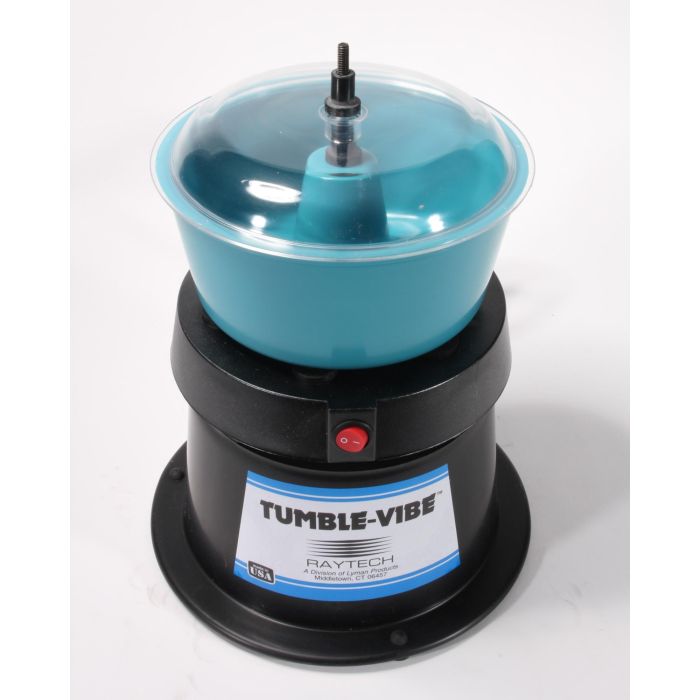
Raytech TV-5 Vibratory Tumbler 23-001
Best for: Surface finishing of pre-shaped stones and small metal items.
Before buying: A vibratory finisher does not replace rotary coarse-shaping; verify 115 V version.
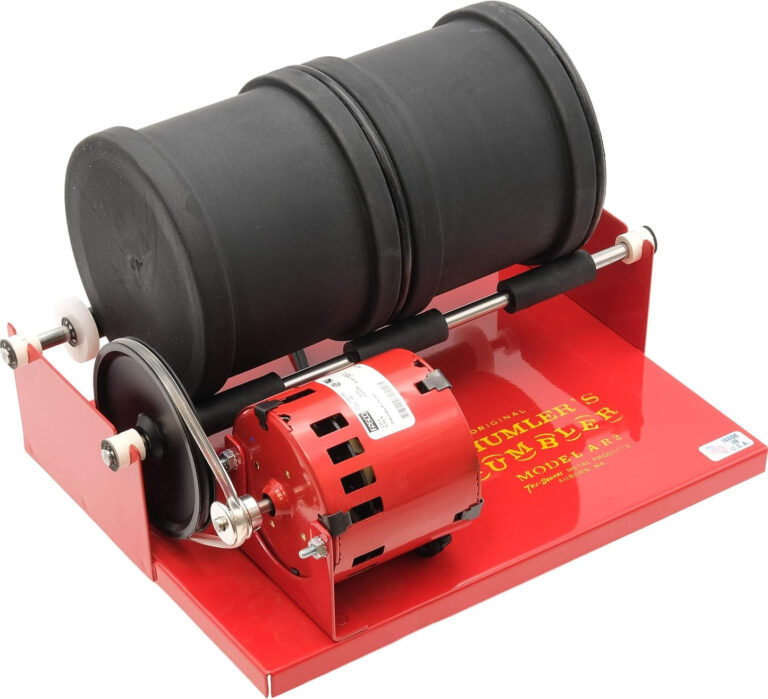
Thumler's A-R2 Dual-Barrel Rotary Rock Tumbler
Best for: Two independent 3 lb rotary batches.
Before buying: 6 lb total; confirm availability, voltage and replacement barrel parts.
Affiliate disclosure: As an Amazon Associate, USA Rockhounding earns from qualifying purchases. Product listings, sellers, prices and availability may change; confirm the exact item on Amazon.
What to check before switching from a rotary to a vibratory tumbler
Vibratory tumbling is often chosen to refine the surface while retaining more of a stone’s original outline. It is not simply a faster replacement for every stage of rotary tumbling. Machine geometry, abrasive stage and load compatibility affect the result; rough with sharp corners or deep pits can still require substantial shaping beforehand.
Practical setup differences
- Stone preparation: Sort out fragile, fractured or very dissimilar specimens before running a finishing batch.
- Load behavior: Verify that the contents circulate as the manufacturer’s instructions describe; a stalled or overloaded bowl produces poor contact.
- Moisture: Follow the machine-specific procedure. Too little or too much water or slurry can change the action and may damage equipment.
- Inspection: Check progress, media condition, noise and temperature using the maker’s recommended intervals.
Which style suits the goal?
For deeply rough stones needing rounded forms, rotary grinding may remain the more suitable beginning. For already-shaped cabochons, preforms or material where outline preservation matters, a compatible vibratory finishing process may be preferable. Verify bowl capacity, spare parts, abrasive compatibility and expected maintenance before purchase. Compare the rotary and vibratory workflows and do not infer that a shorter stage always produces an equivalent surface.
What a vibratory rock tumbler actually changes
A vibratory tumbler is a finishing machine that moves a load through repeated vibration rather than rotating a barrel through a slow rolling cycle. Depending on the design and stage, it can refine the surface while preserving more of a rock’s existing shape. That distinction matters when an operator wants to keep a cabochon outline, crystal-like form, or pre-shaped edge. Vibratory action is not a guarantee of a faster version of every rotary operation. Some rough still needs rotary rounding or other preparation first. Check the exact machine’s approved process before assuming that it can replace an entire tumbling system.
Circulation is the central performance test
The load should move through the bowl or container in the pattern described by the manufacturer. If rocks merely vibrate in one place, pack tightly against a wall, or separate into inactive layers, the intended abrasive contact may not occur. Large stones, small media, slurry consistency, load weight, and container shape all influence circulation. An overloaded machine may have poor movement; an underloaded one may fail to provide useful controlled contact. The visible behavior of the real stone batch is more important than claims about vibration frequency on a sales page.
Compare bowl shape and workpiece geometry
Machines intended for jewelry deburring, cartridge brass, industrial metal parts, or lapidary finishing may have superficially similar bowls but different media and fluid requirements. The shape and size of the bowl affect how pieces travel and whether fragile surfaces are struck repeatedly. Check whether the design can handle the typical dimensions of your stones and whether the manufacturer’s recommended load mix matches your purpose. A bowl that handles many tiny polished pieces may be unsuitable for a few large irregular geodes. Check minimum as well as maximum load guidance.
Choose by the stage you intend to run
If your goal is heavy rounding of angular rough, a rotary coarse stage may be the more appropriate starting point. If your goal is removing fine marks from already-shaped stones, an appropriate vibratory pre-polish or polishing sequence may be efficient. When the stones have pits, fractures, or unsuitable mineral mixtures, a vibratory bowl does not make those problems disappear. Keep rough types and stage goals separate. Instead of buying on a claim of finishing in a fixed number of hours, assess what preparation that advertised figure assumes and whether that matches your collection.
Wet vibratory processes versus dry media
Some vibratory machines are intended for wet slurry; others are sold for dry operations and particular media. Do not add water to a machine or bowl that was not designed for the proposed process. For wet rock polishing, the correct moisture level can strongly affect movement and contact. Too much liquid may dilute the working slurry or disrupt circulation; too little may cause paste-like accumulation or inconsistent finishing. Follow the exact maker’s method, paying attention to electrical safety, seals, splash control, cleanup, and suitable abrasive types. Do not adapt recipes from unrelated metal-finishing equipment.
Media selection changes the load
Ceramic shapes, plastic media, and other products can be manufactured for very different purposes. Abrasive deburring media is not automatically equivalent to nonabrasive spacing pieces. Check composition and whether the product is meant to cut, burnish, or support the parts being processed. Media size should suit the gaps between stones without trapping smaller pieces. Sharp or degraded media can damage softer surfaces. Stage contamination remains a risk; material previously used in coarse grinding may introduce scratches into a final finishing load. Dedicated, labeled media containers simplify quality control.
Assess grit and polish compatibility
A vibratory stone-finishing sequence should come from the manufacturer’s instructions or another technically compatible documented process, not a copied rotary recipe. Check abrasive type, quantity, duration, water or slurry guidance, and cleaning steps. An especially fine finishing product is not a remedy for a surface that still has coarse scratches. If the system is advertised as a fast polisher, determine whether it assumes completely pre-shaped rocks. A machine that saves hours in final polish may still require days of prior preparation elsewhere in the workflow.
Loading by weight and volume
Capacity claims may be listed as bowl volume, pounds of media or total load. Those measurements are not interchangeable. A bowl rated for light plastic parts may not tolerate an equivalent volume of dense mineral specimens. Confirm how the maker defines its rating and whether the advertised figure includes liquid and media. When working with heavy rock, motor, spring, mounting, and container durability become important. Do not exceed approved loads merely because space remains at the top. Underloading may also produce ineffective or damaging movement, so follow the permitted range rather than treating maximum capacity as a target.
Monitoring a batch without excessive handling
Observe progress at safe intervals consistent with the instructions. Excessive checking can contaminate the load and waste time, but unattended abnormal noise, leaks or stalled circulation can damage equipment or specimens. Record the material class, stage, start condition and observations so you can distinguish a product defect from a process problem. Wash and dry a sample for inspection rather than judging a glossy wet surface. If scratches remain, identify the stage responsible instead of repeating final polish indefinitely. Photograph the same sample stones under similar conditions to make results comparable.
Machine construction and serviceability
Inspect the bowl attachment, springs, motor, fasteners and vibration isolation. Continuous motion creates wear and can loosen poorly secured parts. Look for replacement bowls, drive assemblies, switches and manufacturer support. A quiet machine in one review may become noisy on an unstable shelf or with an unsuitable load. Check whether the base must be bolted down or placed on a particular surface. Do not improvise mounting changes that defeat safety features. In a workshop with multiple stations, plan enough clearance so a moving bowl cannot touch stored tools, water containers or electrical cords.
Noise, vibration and the placement problem
Vibratory machines can transmit substantial sound into tables, floors and adjacent rooms. Residential settings may need different equipment and placement from a dedicated outbuilding. Review product sound claims critically because the measured load, surface and distance may not match your own conditions. A rigid stable support and correct operating load are usually more valuable than an unverified household noise-dampening modification. Never obstruct ventilation or trap heat in an improvised soundproof enclosure. Plan for safe access to controls and an adequate workspace for cleaning and inspection.
Cleaning and abrasive contamination
Fine grit travels into corners of containers, measuring spoons, sample trays and rinse bowls. Keep stage-specific tools when possible, and clean the vibratory bowl following the manufacturer instructions. Collect abrasive sediment rather than flushing it into normal plumbing. Inspect small crevices and media before each finer stage. When a batch unexpectedly acquires new random scratches, contamination is among the first causes to investigate. Avoid creating dry airborne dust while emptying or cleaning the system, especially when the material composition is uncertain. Store powders in marked sealed containers.
Which rocks should not enter the bowl?
Delicate open crystal clusters, very friable specimens, strongly fractured rough and mixed minerals with incompatible durability can be damaged even in a process promoted as gentle. Fossils and scientifically important samples require different conservation decisions. Consider whether removing material is even appropriate. A transparent quartz point, for example, may be better preserved in its original form than polished in a barrel. Do not use vibratory equipment to test whether a valuable specimen can survive abrasion. Begin with inexpensive, suitable material and develop a repeatable process before working on important pieces.
Common problem: uneven polish
Uneven finishing can arise when stone surfaces have different hardness, the batch is not fully prepared, or some pieces barely circulate. Examine both the surface and the machine motion. Check whether the stone has pockets or projections that contact media differently from its broad faces. A polishing stage cannot remove a deep crack without substantial reshaping, and an incompatible rock mixture can show variable gloss even under an otherwise correct recipe. Separate material classes and repeat a controlled run before concluding that the machine is defective.
Common problem: bruised edges or chips
If you see fresh light-colored corner marks, evaluate collisions between dissimilar stone sizes, an overly vigorous or unsuitable load, cracked rough and media geometry. Record whether damage first appeared during rough preparation, pre-polish or final polish. A change in the material mix may help more than adding polish powder. Never operate above the stated load to create a tighter pack; overloading can damage both stones and the drive. When fragile specimens repeatedly chip, choose a different method rather than treating the defects as an acceptable cost of polishing.
Common problem: slow progress
A bowl filled with unsuitable abrasive, overabundant water or overly tightly packed media may move without achieving sufficient useful contact. Verify the actual recipe and circulation. Consider whether the surface is not ready for the grade being used. A rock that has a coarse scratch needs an appropriate earlier operation; extending fine polish does not make the process equivalent to grinding. Compare the time and effort of separate pre-shaping with the claimed savings from vibratory finishing. The right equipment is the one that meets your required quality, not necessarily the shortest advertised cycle.
Buyer comparison for three use cases
Occasional hobby finishing: Prioritize a documented stone-specific process, manageable noise, simple cleaning and available consumables. Lapidary shop finishing preforms: Evaluate shape retention, load uniformity, operational repeatability and whether the machine integrates with saws or cabbing stations. Higher-throughput stone production: Compare workpiece ratings, replacement components, cost per finished batch, operator attention and quality control. Do not purchase a large industrial deburring machine solely because its bowl appears similar to a lapidary finisher.
Cost of ownership and the final checklist
Calculate initial equipment and bowl cost, recurring abrasives, media wear, cleaning time, power use, replacement parts, noise constraints and space. Evaluate the supply of suitable rough: a fast machine has little value if material is not ready for the chosen process. Confirm the exact model’s specifications, documentation and warranty, including any restrictions on commercial or continuous use. Use the rotary versus vibratory comparison to decide between workflows, the media guide for loading choices, and the polish guide to investigate finish defects.