Best Professional Rock Tumblers: Buy Throughput You Can Feed
Professional rotary tumblers make sense only when you have enough compatible rough, consumables, cleaning capacity and operating space to use the load volume repeatedly.
Choose equipment from the material and job first—not from the retailer first.
What is the best professional rock tumbler?
The best professional rock tumbler is the smallest high-capacity system that removes a real throughput bottleneck. Before buying 25–75 lb capacity, confirm that you can consistently supply compatible rough, separate stages, handle grit and slurry, and operate the machine in an appropriate location.
A professional tumbler is justified by repeatable throughput—not by owning the largest barrel.
Before moving beyond hobby capacity, estimate how many pounds of compatible rough you can sort, clean and process every month, plus the grit/media/slurry handling that follows.
Direct answers before you buy
When is a 25 lb rock tumbler worth buying?
When smaller barrels are a genuine throughput bottleneck and you can consistently assemble compatible loads. Otherwise multiple smaller barrels can offer more flexibility.
Is a 75 lb tumbler better than several small tumblers?
Not automatically. One large load increases throughput but reduces the ability to separate materials and stages. Multiple barrels can be operationally more flexible.
What changes most at professional tumbler scale?
Material sorting, grit consumption, cleaning, slurry handling, operating location and batch-loss risk all become more important as load size increases.
Should a small rock shop use rotary or vibratory tumblers?
That depends on the desired shape, process stages and material. Rotary and vibratory systems should be treated as different process tools, not simply large versus small machines.
Check the source, model and buying conditions.
Manufacturer pages and manuals support the specifications identified in a guide. Check the exact model and current instructions before purchase; similarly named variants can differ.
A product card’s check date applies to that record. The page revision date does not mean every product was rechecked. Confirm current price, seller, package contents and availability on Amazon.
These guides use published information and editorial selection criteria. Hands-on testing is not claimed unless a guide describes the actual test.
Shopping cards show products with a direct Amazon purchase link. This limits the displayed selection; it is not a comprehensive market comparison. Use the tool-class guidance and current manufacturer instructions to assess other options.
- Highland Park rotary tumblers
These references support product specifications or procedures, not independent proof of performance. Follow the instructions for the exact equipment you use.
Editorial method: read the Gear Review Methodology & Evidence Policy. Affiliate relationships: read the disclosure.
Compare tumbling equipment for workflow and capacity
The dual-barrel Thumler model supports separate rotary loads, Raytech TV-5 uses vibratory action for pre-shaped material, and Lortone 3A is a smaller rotary reference point. These are different workflows, not a ranking by capacity alone.
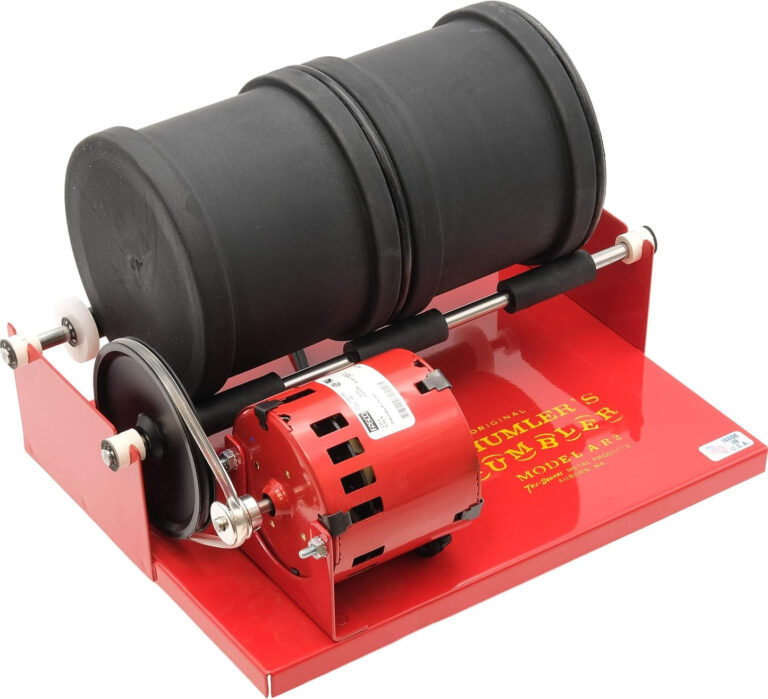
Thumler's A-R2 Dual-Barrel Rotary Rock Tumbler
Best for: Two independent 3 lb rotary batches.
Before buying: 6 lb total; confirm availability, voltage and replacement barrel parts.
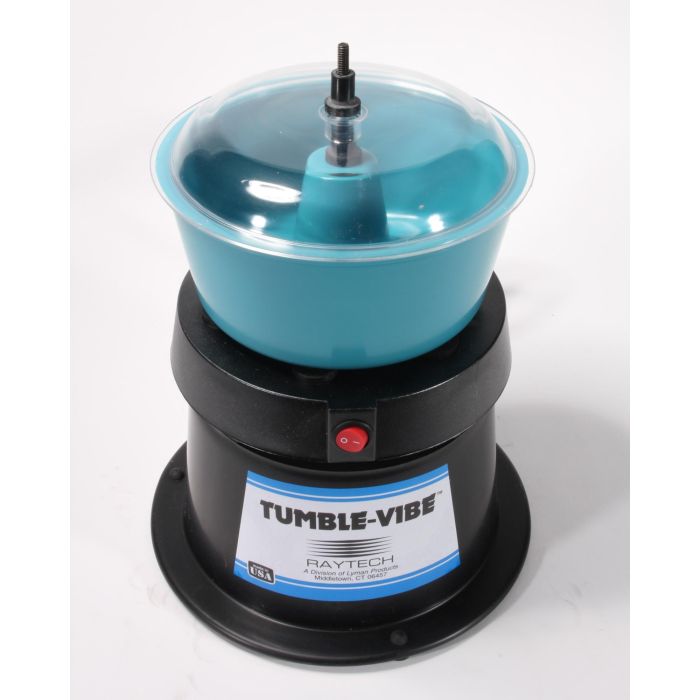
Raytech TV-5 Vibratory Tumbler 23-001
Best for: Surface finishing of pre-shaped stones and small metal items.
Before buying: A vibratory finisher does not replace rotary coarse-shaping; verify 115 V version.
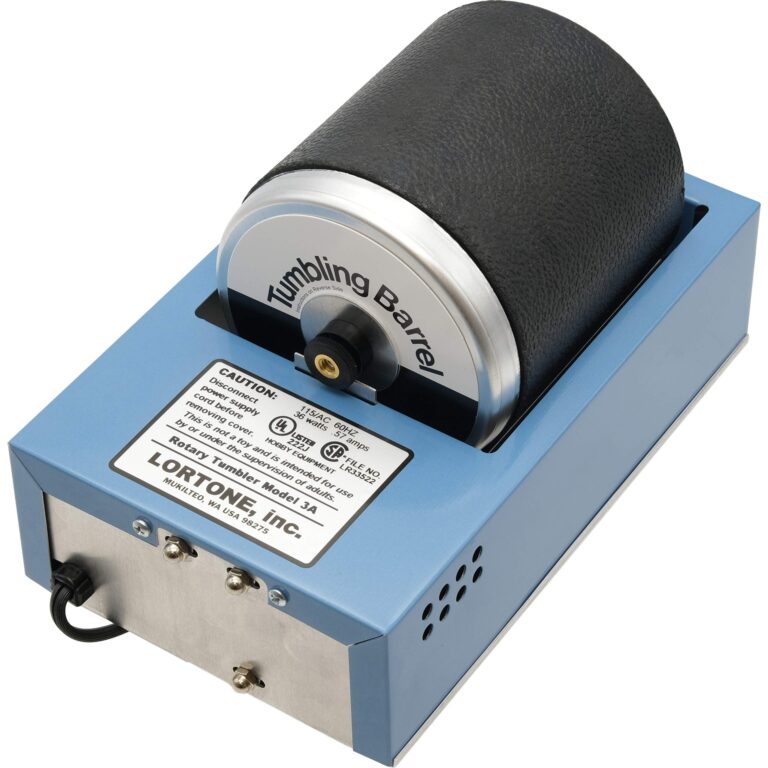
Lortone 3A Single Barrel Rock Tumbler
Best for: A 3 lb rotary tumbler for hobbyists processing smaller batches of agate, jasper and similar tumbling material.
Before buying: Confirm barrel condition, 110–120 V motor, spare belts and seller availability.
Affiliate disclosure: As an Amazon Associate, USA Rockhounding earns from qualifying purchases. Product listings, sellers, prices and availability may change; confirm the exact item on Amazon.
Decide whether a production tumbler will genuinely increase throughput
Large barrels can process more rough, but they also magnify sorting mistakes, noise, loading effort and consumable costs. Compare the usable output of polished stones per month, not the advertised barrel capacity. Mixed batches of unsuitable hardness or poor-quality rough can produce expensive waste at any scale.
Business and workshop comparison checklist
- Batch control: Can you keep comparable material and size classes separate without running underfilled barrels?
- Maintenance: Are replacement belts, lids, bearings and compatible barrels obtainable without long interruptions?
- Operating environment: Check electrical requirements, noise transmission, drainage, slurry handling and the space needed for cleaning.
- Material flow: Estimate sorting time, processing duration, abrasive consumption and finishing yield before investing in higher capacity.
- Redundancy: Several smaller machines may isolate failures and allow different batches to advance independently; one large machine may simplify loading but concentrate downtime.
Questions before scaling up
Will the workshop consistently have enough similar rough to fill the equipment correctly? Can operators safely lift, move and clean the expected working load? Does the budget cover grit, media, maintenance and inspection rather than only the purchase price? A machine sold as professional is not evidence of better results. Use the ownership-cost calculator and consumables planner to compare the complete workflow.
What makes a tumbler suitable for production work?
“Professional” is a marketing term unless a seller defines it through measurable performance. A commercial workshop needs repeatable batch quality, dependable availability, predictable replacement parts, safe operating capacity and labor efficiency. A barrel with a large advertised weight rating does not necessarily produce more saleable stones. Its useful throughput depends on load compatibility, processing duration, preparation, inspection, yield and downtime. Define the end product first: rounded agate, jewelry rough, decorative mixed stones, or finished pieces for a specialist lapidary operation. Different outcomes place different demands on the machine.
Distinguish barrel capacity from finished output
Manufacturers may express capacity as barrel volume or total load weight. That rating does not tell you how much finished stone emerges after material is removed during grinding. Record the starting rough weight, water and media allowance as appropriate, and the mass of saleable pieces that reach the desired standard. Measure the proportion that must be returned to an earlier stage. An oversized machine run partly empty is not always efficient, because the proper tumbling action depends on the approved fill. Conversely, consistently overloaded equipment may strain drive components and reduce product quality.
Model your monthly workflow
Estimate how many batches can proceed in parallel and how long each actually takes with the intended rough. Include sorting, cleaning, inspection, charging or replenishment where relevant, drying, and final quality control. A machine that completes one large batch while all other material waits can create a workflow bottleneck. Multiple smaller barrels permit separate hardness classes and stages, although they require more individual cleaning and monitoring. The best arrangement depends on order mix and labor availability. Avoid promising customers a delivery interval based only on the best-case processing time printed in a product listing.
Rotary or vibratory for a working shop?
Rotary tumblers gradually reshape rough as it rolls through the load. That can be useful for transforming angular field material into rounded stones. Vibratory equipment is often chosen for controlled finishing that retains more of an existing outline. They are not universally interchangeable: some vibratory setups require pre-shaped material, and a shop may benefit from both technologies at different stages. Compare the specific manufacturer’s approved use, stone size, abrasive consumption, operator attention and spare-part network. Faster surface refinement does not mean that a vibratory machine will accomplish the same coarse rounding job.
Small production barrels versus one large machine
Several small units provide flexibility to isolate mixed rough, reserve a barrel for final polish and continue working if a single motor fails. Their drawbacks can include more lids to clean, repeated loading tasks and added floor space or power cords. A large unit can simplify processing when the workshop has a continuous supply of uniform material, but it may concentrate operational risk. A failed seal or drive part can interrupt much more work at once. Ask whether one operator can safely handle a filled barrel or whether the machine requires lifting aids. Equipment selection should account for ergonomics as well as purchased capacity.
Drive design and serviceability
Review motors, belts, rollers, bearings, power controls and lid design. A belt that can be replaced with an available part is a different ownership proposition from a sealed motor assembly that cannot be serviced economically. Check whether the machine can run the sustained duty cycle required by the workshop, subject to actual manufacturer ratings. Inspect guarding and accessible pinch points. Be skeptical of a product advertised for continuous production when it lacks a manual, spare parts or a clear warranty. Ask how routine wear components are obtained and whether the supplier will continue to support the model.
Barrel selection, seals and abrasion
Barrel material influences noise, wear, grip and cleaning. Rubber-lined or resilient containers may reduce sound in some designs, while rigid constructions may have different maintenance requirements. Evaluate the seal carefully: even small leaks can create slurry mess, damage the drive area or interrupt a long polishing stage. A convenient lid matters because production work involves frequent inspection and cleaning. Do not select the least expensive replacement barrel without confirming dimensional and mechanical compatibility. Keep spare gaskets when practical, and inspect them for cracks, embedded abrasive and compression damage before every cycle.
Match equipment to the rock supply
A shop processing homogeneous sound quartz-rich rough may standardize more of its workflow than one accepting varied field specimens. Mixed mineral hardness, cavities, weathered surfaces and delicate inclusions can create unpredictable failures. Sorting stations, reference photos and a repeatable rejection standard may improve final output more than buying a larger motor. If a source has frequent fractured pieces, budget for substantial early-stage removal and reject unsuitable specimens. Never market tumbling as a guaranteed way to make any rough stone polished or valuable. Geological quality and suitability remain fundamental limitations.
Consumable costs grow with scale
Coarse and intermediate abrasives, pre-polish, final polish, cleaning materials, compatible media and wastewater handling all contribute to the finished cost. Large barrels can use substantial quantities even when the powder is inexpensive per unit. Track consumables by stage and saleable output rather than treating an entire grit order as one unallocated expense. A cheaper compound that causes rework may increase total operating cost. Keep enough suitable abrasives on hand to complete the full planned sequence; stopping after coarse grinding because a finishing product is out of stock can delay orders and complicate scheduling.
Water and slurry management
Rock tumbling generates sediment. Arrange a collection and disposal process that meets applicable local requirements; do not send abrasive slurry into normal household drains. Use sealed storage containers where appropriate and prevent fine dried dust from becoming airborne during transfer. Some mineral materials may introduce additional hazards into sediment. A production workshop should know what enters each batch and evaluate relevant dust or waste controls. Poor housekeeping increases both cleaning labor and contamination risk. It can also damage machinery or adjacent tools when abrasive grit spreads across a shared workbench.
Noise and workspace requirements
Long-running tumblers can create vibration and persistent sound. Manufacturer noise claims are only meaningful when the measurement conditions are comparable to your installation. A basement shelf, apartment floor or thin timber table may transmit sound differently from a stable workshop platform. Arrange adequate ventilation, clearance around moving parts, accessible cleaning and a safe electrical environment. Do not bypass enclosures or manufacturer safeguards to quiet an irritating rattle. Before expanding into multiple machines, check building constraints, neighbor disturbance, working hours and what safe operation will require.
Electrical power and running costs
Compare the specified motor draw and duty cycle instead of guessing power consumption from machine size. Actual electricity use depends on how many hours the machine operates, what functions are active and whether ancillary equipment is needed. A simple energy estimate multiplies rated kilowatts by operating hours, but actual measurements are better where available. Account for ventilation, lighting and equipment that processes or filters slurry. A model with lower energy demand may still have a higher total cost if the processing cycle is longer or yield is worse. Energy efficiency is one part of a whole-system decision.
Maintenance log for reliable output
Record operating hours, belt and roller condition, bearings, unusual sounds, seal replacements and any leaks. Maintain a dated checklist before loading and after cleaning. Document the stones, material class, abrasive stage and processing observations separately from equipment repairs so failures can be traced. A recurring loss of circulation may relate to loading rather than the motor; repeated leaks may point to gasket care. Avoid changing multiple process settings while investigating a mechanical issue. For an income-producing machine, the ability to reproduce a successful cycle and recover safely from faults is a major purchasing criterion.
Quality-control criteria before selling
Inspect a dried sample under controlled light. Look at consistency of rounding, visible scratches, chips, cracks and whether the finish meets the advertised grade. Keep distinct categories for fully polished pieces, material requiring another stage and pieces that should not be sold as premium. Do not mix a few exceptional stones into photography that implies the entire batch is equivalent. Record yield by material source to identify which rough makes economic sense. A higher-capacity machine does not compensate for a weak quality-control process or for misleading product descriptions.
Calculate the total cost of ownership
Build a purchase comparison using machine and barrel cost, shipping, compatible abrasives, expected spare parts, energy, consumable water, cleaning time, floor space and likely downtime. Include the opportunity cost of machines sitting idle because rough is unavailable or an essential abrasive is missing. For revenue estimates, use actual yield and selling price rather than the theoretical maximum barrel weight. Reserve funds for maintenance and unexpected scrap. A lower initial purchase price is not necessarily cheaper over several seasons, especially if the supplier cannot provide replacement components.
Evaluating warranty and supplier claims
Check the exact model, production capacity definition, eligible use conditions and length of support. Some warranties distinguish hobby and commercial use, or specify limits on continuous operation. Find the machine manual before ordering and verify safe loading, approved abrasives and maintenance expectations. Seek documented specifications rather than statements that a machine is used by professionals. If a supplier does not explain its capacity measurement, technical limits or parts access, comparison with another model becomes uncertain. Keep screenshots or copies of product specifications and purchase conditions for later reference.
Three scenarios for choosing scale
Occasional custom orders: Multiple small barrels may be easier to schedule because materials and stages vary. Uniform decorative-stone output: A larger proven rotary platform may be efficient once reliable rough supply and measured demand are established. Precision finishing workshop: Dedicated vibratory finishing can complement grinding or cutting equipment where preserving the existing shape matters. None of these decisions can be made from barrel capacity alone. Validate with a pilot run and compare finished output, labor and rejects before committing to production expansion.
Safety and final purchase decision
A professional setup should reduce risks, not merely process more material. Use appropriate guards, stable supports, safe electrical practices around wet work and suitable lifting methods. Prevent exposure to mineral dust and keep waste contained. Follow the actual maker’s servicing and load instructions. Choose the tumbler that consistently finishes the material you really have, with spare parts you can obtain and processes you can document. For detailed selection, compare vibratory tumbler guidance, media handling, and the lapidary ownership-cost calculator.