Best Mohs Hardness Kits: Controlled Scratch Testing
Choose a hardness-testing system for repeatable property evidence—not as a one-test mineral naming device.
Choose equipment from the material and job first—not from the retailer first.
What is the best Mohs hardness kit?
A useful Mohs kit provides consistent reference points and a workflow that protects the specimen. Hardness is only one property and scratch testing is destructive, so it should be combined with other evidence and avoided on valuable surfaces when possible.
The test surface can be sacrificed.
Hardness is useful when you can expose/test a representative surface without damaging a specimen whose value depends on preservation.
One scratch result proves identity.
Weathering, coatings, aggregates and mixed minerals can mislead. Stack hardness with density, streak, luster, habit and context.
Dedicated hardness-testing option
Mohs' Hardness Test Kit for Industrial Use
Best for: Controlled scratch-hardness testing when a dedicated Mohs reference kit is justified
- Capacity/class
- Mohs hardness testing set
- Power
- None
- Availability
- Check Amazon for current availability
- Dedicated hardness-testing route
- Useful when a property-based ID workflow requires repeatable scratch references
- Scratch tests are destructive
- Weathered surfaces and coatings can mislead; expose a fresh surface only when appropriate
Check the source, model and buying conditions.
Manufacturer pages and manuals support the specifications identified in a guide. Check the exact model and current instructions before purchase; similarly named variants can differ.
A product card’s check date applies to that record. The page revision date does not mean every product was rechecked. Confirm current price, seller, package contents and availability on Amazon.
These guides use published information and editorial selection criteria. Hands-on testing is not claimed unless a guide describes the actual test.
Shopping cards show products with a direct Amazon purchase link. This limits the displayed selection; it is not a comprehensive market comparison. Use the tool-class guidance and current manufacturer instructions to assess other options.
- Mineralab hardness tools
These references support product specifications or procedures, not independent proof of performance. Follow the instructions for the exact equipment you use.
Editorial method: read the Gear Review Methodology & Evidence Policy. Affiliate relationships: read the disclosure.
Photographed Mohs hardness test kit
This Mineralab kit is an industrial version intended to test relative scratch hardness. It is not a non-destructive gemological identification device. Collectors should test only an inconspicuous and expendable specimen surface, compare the result with other tests, and avoid scratching valuable or rare mineral examples.
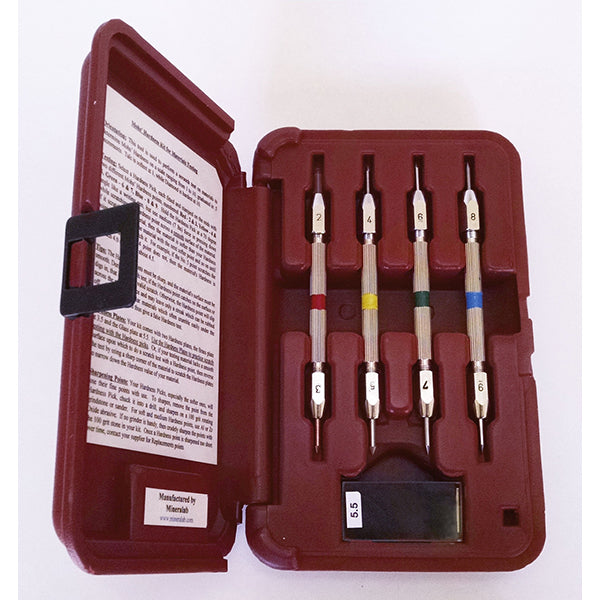
Mineralab Mohs Hardness Test Kit — Industrial Model HD2
Dedicated reference hardness-point kit; designed mainly for concrete and industrial materials, and also usable for controlled relative hardness tests on appropriate mineral samples. Review exact reference-point range and included instructions.
Check exact listing on Amazon ↗
Amazon price, seller and stock may change.
Affiliate disclosure: As an Amazon Associate, USA Rockhounding earns from qualifying purchases. Confirm the exact variant, current price and seller before buying. These are model-matched product photographs, not independent hands-on reviews.
How to choose and use a Mohs hardness kit
The Mohs scale ranks scratch resistance rather than absolute strength. A hardness test can remove material or damage a polished surface, so start with a small inconspicuous area of an expendable specimen. Do not test valuable jewelry or delicate crystals merely to obtain a number.
Check the kit and its reference materials
- Reference points: ensure known hardness standards or picks are identifiable, clean and appropriate for the range you expect to examine.
- Clear instructions: look for an explanation of testing in both directions when narrowing the hardness interval.
- Portability: protect points and reference pieces from damage or mixing in a field bag.
- Recordkeeping: note the tested surface, observed scratch and any uncertainty from weathering or coatings.
Avoid common interpretation mistakes
A powder streak, dirt transfer or mark on a surface is not necessarily a true scratch. Compare after gently cleaning the test area. Weathered rinds, different crystal directions, mixed specimens and fragile cleavage planes can produce misleading observations. A scratch test alone rarely establishes mineral identity; consider streak, luster, crystal form, specific gravity and geological context together.
For nondestructive initial observations and additional equipment, see the mineral identification collection. Collecting permission and safe specimen handling come before field testing.