Best Rockhounding Loupes: Why 10× Is the Field Starting Point
Compare compact magnification by optical design, lens diameter, field ergonomics and whether hands-free mounting matters.
Choose equipment from the material and job first—not from the retailer first.
What magnification loupe is best for rockhounding?
A 10× loupe is a practical field starting point because it reveals grains, crystals and small textures while retaining a usable field of view. Lens design, lens diameter, lighting and working distance affect usefulness as much as nominal magnification.
Source-checked field loupe options
JARLINK 30X/60X Illuminated Jeweler's Loupe
Best for: Close field inspection of small mineral features, grains and inclusions
- Capacity/class
- 30X/60X illuminated folding loupe
- Power
- Battery illuminated
- Availability
- Check Amazon for current availability
- Exact model/ASIN is mapped to the relevant Gear Hub workflow
- Direct Amazon purchase path is separated from editorial recommendation logic
- Confirm the exact current variant, included accessories and seller on Amazon before purchase
- Amazon price and availability can change at any time
10× is a practical field baseline because it reveals grains, cleavage, crystal form and tiny textures without making the field of view unusably small.
Optical design, lens cleanliness, lighting and working distance matter as much as the number printed on the loupe.
Check the source, model and buying conditions.
Manufacturer pages and manuals support the specifications identified in a guide. Check the exact model and current instructions before purchase; similarly named variants can differ.
A product card’s check date applies to that record. The page revision date does not mean every product was rechecked. Confirm current price, seller, package contents and availability on Amazon.
These guides use published information and editorial selection criteria. Hands-on testing is not claimed unless a guide describes the actual test.
Shopping cards show products with a direct Amazon purchase link. This limits the displayed selection; it is not a comprehensive market comparison. Use the tool-class guidance and current manufacturer instructions to assess other options.
- Geology.com 10x hand lens
- Donegan Eyeglass Loupe
These references support product specifications or procedures, not independent proof of performance. Follow the instructions for the exact equipment you use.
Editorial method: read the Gear Review Methodology & Evidence Policy. Affiliate relationships: read the disclosure.
Compare field inspection optics
BelOMO 10× triplet is a pocket loupe for mineral observation. Carson MM-300 and MM-350 are higher-magnification microscopes for smaller details, not replacement loupes. Compare working distance, light and field practicality before choosing.

BelOMO 10x Triplet Loupe
Best for: Checking mineral grains, crystal faces and inclusions with an achromatic 10× triplet lens.
Before buying: Confirm a genuine BelOMO LP-3-10x and the desired protective case.
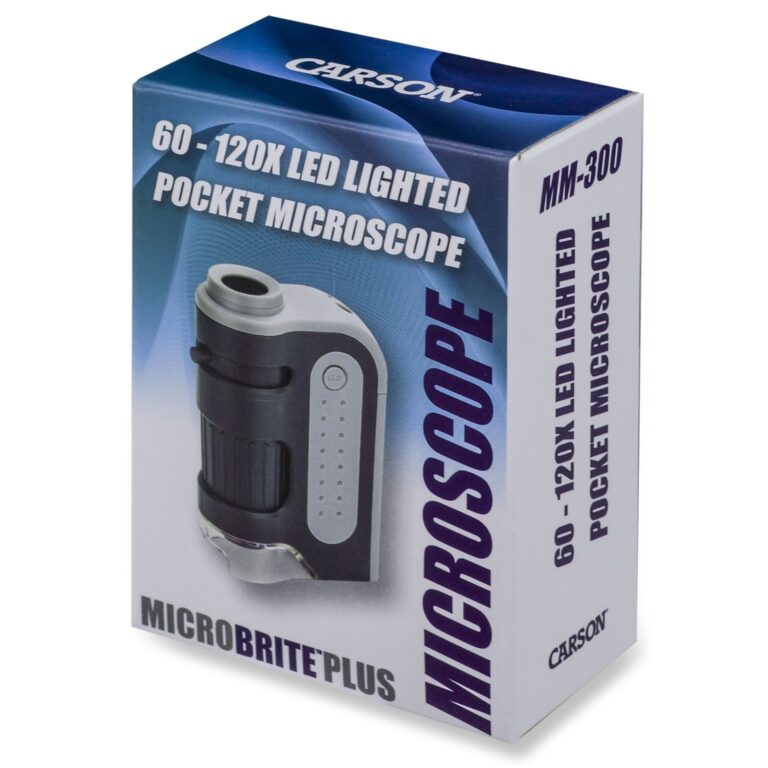
Carson MicroBrite Plus MM-300 Pocket Microscope
Best for: Inspecting small mineral features at 60–120× where a 10× loupe lacks magnification.
Before buying: Requires stable positioning and illumination; not a replacement for optical mineral identification tests.
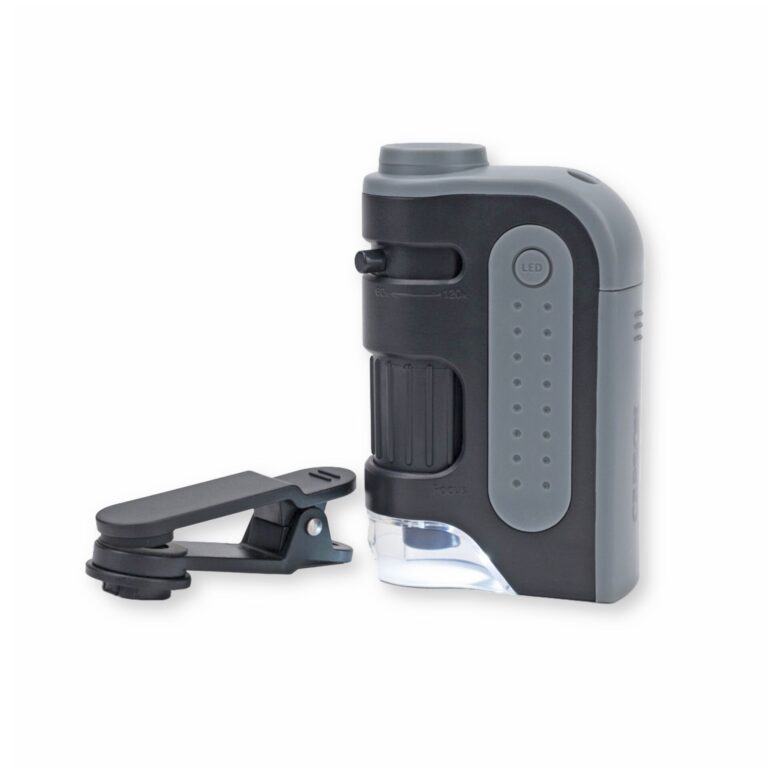
Carson MicroBrite Pro MM-350 Microscope with Smartphone Clip
Best for: Photographing mineral grains and texture at 60–120x using the included smartphone adapter clip.
Before buying: Phone alignment and compatible camera lenses vary; check battery and clip contents.
Affiliate disclosure: As an Amazon Associate, USA Rockhounding earns from qualifying purchases. Verify the exact product, current price and availability with the seller.
What makes a hand lens useful in the field?
A loupe helps examine grain boundaries, small crystals, fracture texture and surface features that are difficult to see with the unaided eye. The most useful lens is one you can hold steadily, focus quickly and keep clean, not necessarily the one with the highest advertised magnification.
Compare optical and practical features
- Magnification: greater magnification generally narrows the field of view and can make small hand movements more noticeable.
- Image quality: evaluate edge distortion, color fringing and whether the lens delivers a clear usable center.
- Working distance: test how comfortably you can examine a rough surface without touching fragile crystal edges.
- Field durability: a protected lens, secure cover and accessible carrying method reduce scratching or loss.
A repeatable observation method
Use good daylight or a suitable portable light, brace your elbows and bring the specimen slowly into focus. Examine more than one surface because weathering, dirt and iron staining can conceal important textures. Write down observations such as grain shape, cleavage or visible inclusions before deciding what the mineral might be.
Do not use magnification alone as proof of a mineral identity or gemstone quality. Pair loupe observations with other documented tests from the identification equipment guides and record the locality evidence separately.
Why a hand loupe remains one of the most useful geological tools
A hand loupe makes mineral textures and crystal features visible without requiring a workbench, batteries, or a large microscope. It is useful for examining cleavage, inclusions visible at modest magnification, surface grain boundaries, tiny crystal habits and distinguishing a glassy face from a coated or weathered surface. Its role is observation, not automatic identification. Two minerals may appear similar even under excellent optics, and no loupe replaces a hardness test, provenance evidence or appropriate scientific analysis. Choose a lens that lets you see a genuinely useful area clearly rather than the highest possible magnification number.
10× as a practical field starting point
A high-quality 10× loupe balances working distance, field of view and hand stability for many collecting tasks. It helps when the user can hold a specimen in one hand and the lens in the other while keeping the eye close enough for a sharp image. Higher-powered handheld models can expose fine features but magnify tremor and require more precise alignment. If viewing an entire small crystal matters, a narrower field may make the observation more difficult. Many experienced collectors prioritize reliable optics and a comfortable case over an aggressively advertised 30× or 60× marking.
Triplet lenses versus simpler optical construction
A triplet loupe uses a multi-element optical design intended to reduce certain aberrations. It may offer more usable edge clarity and truer color when well manufactured, which is valuable for a small mineral surface viewed under changing outdoor light. However, the label “triplet” does not guarantee quality; optical assembly, coating, alignment and quality control all matter. Compare the clarity of detail across the central and outer viewing area. In a shop, inspect known printed micro-detail or familiar mineral samples under identical lighting rather than relying solely on a dramatic advertised enlargement.
What distortion looks like in actual use
A low-quality loupe may render a central area sharply while stretching or blurring features near the rim. Chromatic aberration can appear as colored fringes along boundaries, making color judgment less reliable. Field curvature means that a textured mineral face cannot all be in focus at once on an otherwise even plane. Some distortion is easier to notice on a ruled grid than on rocks. A more expensive lens is not automatically distortion-free, but consistent focus and modest edge errors make it easier to compare crystal shape, cleavage and delicate surface textures.
Working distance, depth of field and eye placement
A hand loupe often works best when held close to the eye while the specimen is brought toward the lens until it is in focus. This technique reduces the need to move the lens and keeps viewing more stable. Working distance becomes tighter as magnification increases. Deep pits and sharply projecting crystal clusters can be frustrating because different surfaces lie at different distances from the optical plane. Adequate depth of field is more useful than spectacular magnification if the specimen has substantial relief. Do not push a metal lens housing into fragile crystals to find focus.
Field illumination for metallic and transparent minerals
Direct hard sunlight can create glare on polished quartz and metallic mineral faces. Try shade, angled diffuse daylight, or a small light moved to reveal changes in luster. Transparent material may benefit from a bright background, while opaque grains are better seen when light reveals surface relief. A built-in LED can help inside a dark field shelter, but strong uneven lighting may hide textures or distort color. When color is important, observe the same area in more than one reliable lighting condition. Do not treat the lamp’s blue or warm hue as a property of the specimen.
Examine cleavage and fracture without creating new damage
Cleavage is the tendency to break along particular structural planes; fracture describes breakage outside those directions. A loupe can reveal repeated flat reflective surfaces or shell-like fracture on suitable specimens. Yet crystal faces, weathered surfaces and human-made saw marks can resemble cleavage in a single glance. Turn the specimen slowly to study multiple orientations. Whenever possible, use naturally existing edges rather than cutting or scratching a valuable sample. If the visual clues conflict, record them instead of forcing the rock into a familiar label such as quartz or calcite.
What a loupe can and cannot show about inclusions
Small included crystals, bubbles and grain boundaries may be visible under modest enlargement. Their shape and relationship to the surrounding material can give clues about formation, but appearance alone rarely establishes origin, treatment or species with certainty. A magnifying glass may reveal the presence of a small needle-like feature without determining what the needle is made from. For gem identification, specialist instruments and laboratory methods are sometimes necessary. Avoid advertising a pocket magnifier as capable of proving natural gemstone origin or authenticating a valuable specimen on its own.
Comparing the photographed products above
The BelOMO 10× triplet is in the field-loupe class and is appropriate for collectors prioritizing uncomplicated portable magnification. The Carson pocket microscopes offer different, higher-magnification inspection workflows; they require steadier positioning and can be less convenient for quickly surveying a large rock surface while standing outdoors. They should not be ranked merely by magnification against a 10× loupe. If your goal is scanning dozens of hand samples, use a comfortable loupe. If your goal is documenting tiny grains at a bench, consider a microscope with appropriate illumination and support.
Loupe durability and how to carry it
Field equipment may be exposed to grit, water, dust and accidental drops. A folding lens housing can protect the optical surfaces during transport, but only when closed properly. A lanyard or secure pocket reduces loss among gravel or tailings. Check the hinge and casing for looseness; a lens that wiggles in its mount can make consistent inspection difficult. A robust protective case is worth considering if the tool shares a backpack with hammers, chisels or dense specimens. Never store loose glass optics where sharp rock fragments can scratch them.
Cleaning an optical lens without scratching it
Blowing loose dust with a suitable blower is preferable to grinding abrasive grit across the lens with a cloth. Use a clean microfiber cloth and a cleaner approved for the lens surface when necessary. Avoid solvents or abrasive household cleaning products that may damage coatings or adjacent materials. If the loupe is covered in muddy field dust, remove loose particles carefully before wiping. Keep lens surfaces free of skin oils to preserve contrast. A dirty high-priced triplet may perform worse than a clean simple lens, so maintenance is part of the buying decision.
How to record a useful observation
Photograph the whole specimen first, then note where the magnified feature was found. Include specimen identifier, approximate scale, luster, observed crystal shape and any clear grain or cleavage pattern. A phone camera aligned behind the loupe can sometimes make a record but may introduce reflections, vignetting and distortion. An inexpensive tripod or bench setup may improve repeatability for frequent documentation. If a feature cannot be photographed, draw its outline and orientation. A clear observation recorded with uncertainty is more scientifically useful than an unsupported species name.
Undergraduate and classroom use
Students benefit from comparing the same known specimens using one consistent magnification before switching optics. A reliable 10× loupe, labeled teaching collection and good reference material can demonstrate luster, cleavage, grain form and mineral associations. Ask the learner to describe what was actually seen before giving the identification. Avoid using a rare or hazardous mineral as a scratch-test demonstration. Some rock samples produce dust or contain potentially harmful substances, so follow appropriate safety rules for specimen handling and cleaning.
Field use around outcrops and moving terrain
Stop on secure ground before focusing through a loupe. Tunnel-like attention on a tiny specimen can distract a collector from unstable slopes, cliff edges, loose gravel or oncoming traffic beside roadcuts. Keep one hand available for balance when necessary. Do not inspect specimens while climbing, wading or crossing a stream. Decide where to put the loupe so it will not fall into inaccessible terrain or contaminate a sensitive collecting site. A field tool is only useful if its use does not make the activity less safe.
Buying checklist: what specifications matter?
Compare the true optical magnification, lens diameter, optical design, center and edge clarity, illumination dependence, housing durability, case and any published warranty. Consider the specimen type: chunky rocks and crystals usually need a different viewing arrangement from mounted gemstones or tiny polished inclusions. Avoid listings that imply every optical feature improves in direct proportion to headline magnification. If you can test in person, inspect a known sample under real field lighting. If ordering online, check the exact model number, packaging and seller rather than assuming all products advertised with the same magnification are identical.
When to upgrade to a microscope
Move beyond a loupe when you repeatedly need greater detail, hands-free positioning, controlled illumination or photo documentation of small grain textures. A handheld digital microscope may be convenient for education but can distort colors and lacks the optical flexibility of specialized binocular equipment. A proper gemological stereo microscope has its own capabilities and maintenance demands, and not every geology hobby requires one. For ordinary collecting, a good loupe plus a well-organized mineral reference collection can remain sufficient for years. See gemological microscope selection and identification kit methodology.
Final decision
If portability, ease of use and reliable field observations are your priorities, a comfortable well-made 10× loupe is a strong baseline. Higher-power options have a role when specimens and working conditions justify them, not simply because the number is larger. Compare the photographed exact models, verify product availability and never infer definitive mineral identification from appearance alone. In the field, focus first on specimen provenance, careful observation and personal safety; upgrading magnification should serve a documented question.
JARLINK 30×/60× Illuminated Loupe: a close-inspection companion to a 10× field lens
For small crystals, specimen edges and jewelry-scale surface details, this folding dual-lens loupe provides two advertised magnifications: 30× (22 mm primary lens) and 60× (12 mm secondary lens). Built-in LED lighting can help with close inspection, but the high magnification also narrows the usable view and requires a short working distance. This is an accessory for stationary specimen examination, not a replacement for a comfortable 10× triplet when scanning rough rocks outdoors.

JARLINK 30× 60× Illuminated Jewelers Loupe (single, black)
Best for: tabletop inspection of tiny mineral textures, inclusions and specimen details where a 10× hand lens cannot resolve enough.
Compared with a 10× triplet: higher advertised magnification and integrated illumination, but a smaller field of view, shorter focus distance and more difficult hand stabilization. Choose a 10× triplet first for routine outdoor geology; add this if you need close examination of small specimens.
Check before buying: the single black folding loupe, not a two-pack or 30×/60×/90× set; LED and button-cell accessories; seller’s current package and terms. Magnification alone cannot confirm mineral identity.
View exact JARLINK loupe on Amazon
Amazon ASIN B078N34WZR. Current price, stock, seller and condition are not independently guaranteed.
Affiliate disclosure: As an Amazon Associate, USA Rockhounding earns from qualifying purchases. This comparison uses published product specifications and does not claim hands-on testing.
Additional equipment configurations: compare the actual tools and included accessories
These are distinct Amazon listings. Compare the exact model and bundle components rather than assuming accessories change a tool’s core capabilities.
JARLINK two-pack 30×/60× illuminated folding jewelers loupes
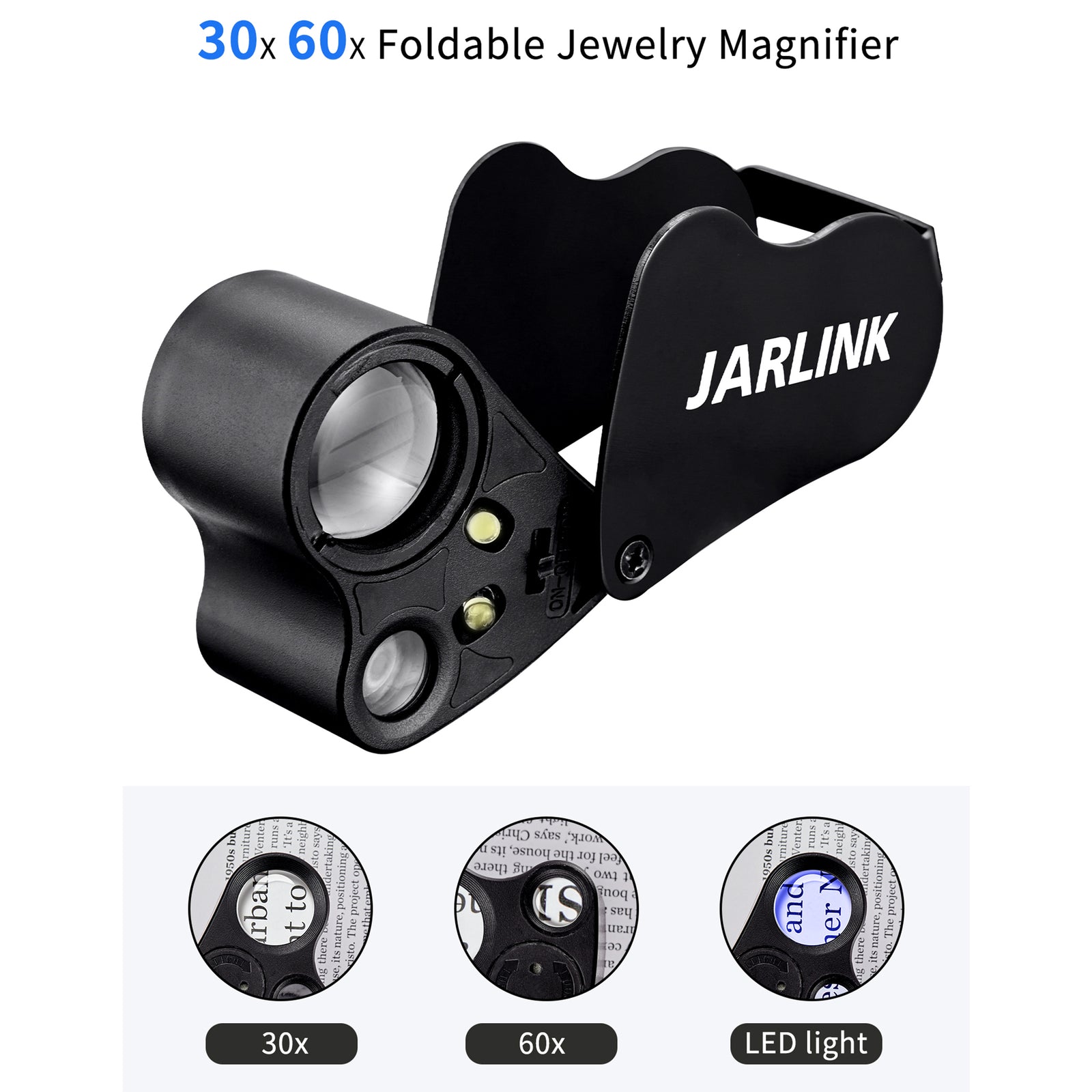
Package: The Amazon ASIN describes a two-pack of JARLINK 30×/60× foldable LED jewelers loupes. The locally stored image shows one of the folding 30×/60× loupe units, not both items in the pack.
Buyer comparison: Compared with the single JARLINK 30×/60× ASIN already listed on this page, the two-pack is for sharing or keeping a spare, not for gaining greater magnification. Compared with a 10× triplet field lens, the 30×/60× loupe has a shorter working distance and narrower field, so a 10× loupe remains easier for routine outdoor rock identification. Check the current two-unit package and batteries before ordering.
Affiliate disclosure: As an Amazon Associate, USA Rockhounding earns from qualifying purchases. No current price, availability, seller condition or hands-on performance is claimed.
JARLINK mixed-magnification loupe kits
These packs include a model-matched 30×/60× illuminated folding loupe plus additional inspection tools. Check the specific style and battery list on each Amazon page; magnification alone does not establish mineral identity.
JARLINK two-style illuminated loupe set (30×/60× plus 30×/60×/90×)
The two-piece listing combines a folding 30×/60× LED loupe with a separate 30×/60×/90× illuminated loupe offering an additional magnification setting and UV light. The photo below shows only the matching 30×/60× component.
Buyer comparison: Compared with a single 30×/60× field loupe, this gives a second inspection style and an additional 90× setting. Higher magnification is not necessarily better for rapid field screening: focus distance and field of view become more restrictive.
Photo scope: One exact JARLINK 30×/60× folding loupe component is pictured; the additional loupe(s) and 90× unit are not shown.
Check exact configuration on Amazon
ASIN B08RSB7S79 · Verify seller, bundle contents, condition, stock and current price on Amazon.
JARLINK three-piece illuminated loupe kit with 30×/60× and 90× options
The listed three-piece set includes 30×/60× and 30×/60×/90× magnifier styles with LED/UV illumination on the 90× model. The local photograph shows one 30×/60× folding component only, not the other pieces.
Buyer comparison: Compared with the two-piece JARLINK set above, this is a larger kit for sharing or keeping additional loupes in separate field bags. The extra unit does not change the optical limits of the individual lenses. Verify batteries and exact style counts before purchase.
Photo scope: One exact JARLINK 30×/60× folding loupe component is pictured; the additional loupe(s) and 90× unit are not shown.
Check exact configuration on Amazon
ASIN B0CP5JC3CR · Verify seller, bundle contents, condition, stock and current price on Amazon.
Affiliate disclosure: As an Amazon Associate, USA Rockhounding earns from qualifying purchases. Local images show the exact pictured component, not every item in the kits. No independent hands-on test or current price, availability or condition is claimed.