Whether you can collect a rock in the United States depends less on the rock than on who manages the ground it is lying on. The same agate can be legal to pick up on one side of a fence and illegal on the other. This guide sets out the general rule for each type of land, the exceptions that catch people out, and how to check a specific place. Local rules always win over the general rule, so treat this as the starting point and confirm with the manager.
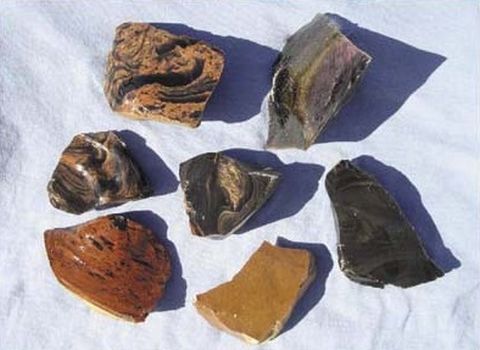

Quick answer by land type
| Land type | General rule for hobby collecting | Check before you go |
|---|---|---|
| Bureau of Land Management (BLM) | Usually allowed: reasonable amounts of rocks, minerals, gemstones, common invertebrate fossils and petrified wood for personal use, with hand tools | Mining claims, special areas, national monuments, local limits |
| National forests (USFS) | Often allowed for small amounts for personal use; recreational panning allowed in many areas | Forest and district rules, wilderness, claims, closures |
| National parks and most monuments | Not allowed | Nothing to check: leave everything in place |
| State parks | Usually not allowed, with notable exceptions | The individual park’s rules |
| State trust lands | Varies by state; often needs a permit or recreation pass | State land office |
| National grasslands | Often allowed for surface collecting of rocks; vertebrate fossils protected | Grassland ranger district |
| Mining claims | Not without the claimant’s permission | BLM Mineral and Land Records System |
| Private land | Only with the owner’s permission | County parcel viewer, owner contact |
| Tribal lands | Only with the tribe’s permission | Tribal government |
| Fee-dig mines and private collecting sites | Allowed on the operator’s terms | Season, fees, what you may keep |
Bureau of Land Management land
BLM land is the most open public land for rockhounds, and most of it is in the West. Federal rules allow you to collect reasonable amounts of rocks, mineral specimens, semi-precious gemstones and common invertebrate fossils for personal, noncommercial use without a permit, using hand tools and without causing more than minor surface disturbance.
- Petrified wood has its own federal limit: 25 pounds plus one piece per person per day, and no more than 250 pounds per person per calendar year. You cannot pool allowances with friends to take a larger piece, and you cannot sell what you collect without a contract.
- Mining claims: collecting on an active claim is not allowed without the claim holder’s permission. Claims are common in gold country and productive gem areas.
- Special areas: some BLM national monuments, wilderness study areas, areas of critical environmental concern and developed recreation sites have their own restrictions.
- Vertebrate fossils (bones, teeth and tracks of animals with backbones) may not be collected without a research permit.
- Artifacts such as arrowheads, pottery and historic items are protected. Leave them where they lie.
Source: Bureau of Land Management, Can I keep this?
National forests
The Forest Service generally allows the collection of small amounts of rocks and minerals for personal, noncommercial use, and recreational gold panning with hand tools is allowed in many forests. Rules are set by each forest and ranger district, so they vary more than BLM rules. Wilderness areas, research natural areas, developed campgrounds and areas with mining claims can be off limits. Call or check the website of the ranger district before you go, especially if you plan to use a sluice or dig in a stream.
National parks and monuments
Collecting rocks, minerals, fossils, plants or artifacts is not allowed in National Park Service areas. This includes famous rock destinations such as Petrified Forest National Park. Many of these places are still worth a visit to see the geology, and some have nearby BLM land or private shops where you can collect or buy material legally.
State parks
Most state parks do not allow collecting. A few are known precisely because they do, such as Crater of Diamonds State Park in Arkansas and Rockhound State Park in New Mexico, and some coastal parks allow limited beach collecting. Rules are park by park, so read the rules of the specific park.
Beaches and rivers
Beach and river rules depend on who owns the shore or bed. Some states allow small amounts of beach rocks and agates outside protected areas; others prohibit removing anything. Fossil collecting in rivers can need a state permit, for example Florida’s permit for vertebrate fossils on state lands and South Carolina’s hobby diver licence for river fossils.
Private land
Ask first, every time. Most productive sites in the East and Midwest are on private land. Use your county’s online parcel viewer to identify the owner, explain what you would like to collect and how, and respect the answer. Many quarries and gravel pits refuse visitors for insurance reasons, but some allow organised club trips.
How to check a specific place
- Find the place on the map and read its status and source.
- Confirm who manages the land with a public land map or county parcel viewer.
- Check for mining claims in the BLM Mineral and Land Records System if you are on federal land in a mining area.
- Read the manager’s current rules and closure notices, or call the office.
- Bring hand tools only unless you have permission for more.
Read how map statuses work to understand what the map tells you about each place.