Best Digital Scales for Gemstones: Capacity, Readability & SG Compatibility
Choose a gemstone scale from specimen mass, required readability, calibration workflow and whether specific-gravity measurement is part of the job.
Choose equipment from the material and job first—not from the retailer first.
What scale is best for gemstones?
Choose a scale whose capacity comfortably holds the specimen and whose readability is fine enough for the measurement you need. For specific gravity work, also confirm that the scale can support the intended hydrostatic fixture and tare load.
Readability and capacity must both fit.
A scale with large capacity but coarse readability can be poor for small gems; a highly sensitive pocket scale can be useless if the SG fixture consumes too much of its capacity.
Source-verified gemstone scales
Weigh Gram Digital Pocket Scale 200g x 0.01g
Best for: Low-cost portable specimen and gemstone weighing when 0.01 g readability is sufficient
- Capacity/class
- 200 g × 0.01 g pocket scale
- Power
- Battery powered
- Availability
- Check Amazon for current availability
- Exact model/ASIN is mapped to the relevant Gear Hub workflow
- Direct Amazon purchase path is separated from editorial recommendation logic
- Confirm the exact current variant, included accessories and seller on Amazon before purchase
- Amazon price and availability can change at any time
MAXUS Precision Pocket Scale 500g x 0.01g
Best for: Portable specimen weighing with more capacity than a small carat-scale format
- Capacity/class
- 500 g × 0.01 g pocket scale
- Power
- Battery powered
- Availability
- Check Amazon for current availability
- Exact model/ASIN is mapped to the relevant Gear Hub workflow
- Direct Amazon purchase path is separated from editorial recommendation logic
- Confirm the exact current variant, included accessories and seller on Amazon before purchase
- Amazon price and availability can change at any time
Check the source, model and buying conditions.
Manufacturer pages and manuals support the specifications identified in a guide. Check the exact model and current instructions before purchase; similarly named variants can differ.
A product card’s check date applies to that record. The page revision date does not mean every product was rechecked. Confirm current price, seller, package contents and availability on Amazon.
These guides use published information and editorial selection criteria. Hands-on testing is not claimed unless a guide describes the actual test.
Shopping cards show products with a direct Amazon purchase link. This limits the displayed selection; it is not a comprehensive market comparison. Use the tool-class guidance and current manufacturer instructions to assess other options.
- Mineralab scales and balances
These references support product specifications or procedures, not independent proof of performance. Follow the instructions for the exact equipment you use.
Editorial method: read the Gear Review Methodology & Evidence Policy. Affiliate relationships: read the disclosure.
Two actual precision pocket scales for gemstones
Both products pictured below are pocket digital scales, not gem refractometers or laboratory balances. They show 0.01 g readability, which is not a promise of 0.01 g measurement accuracy in all conditions. For stones below one carat or tasks requiring very small increments, choose a more suitable verified instrument. Clean and calibrate according to the manufacturer’s instructions.
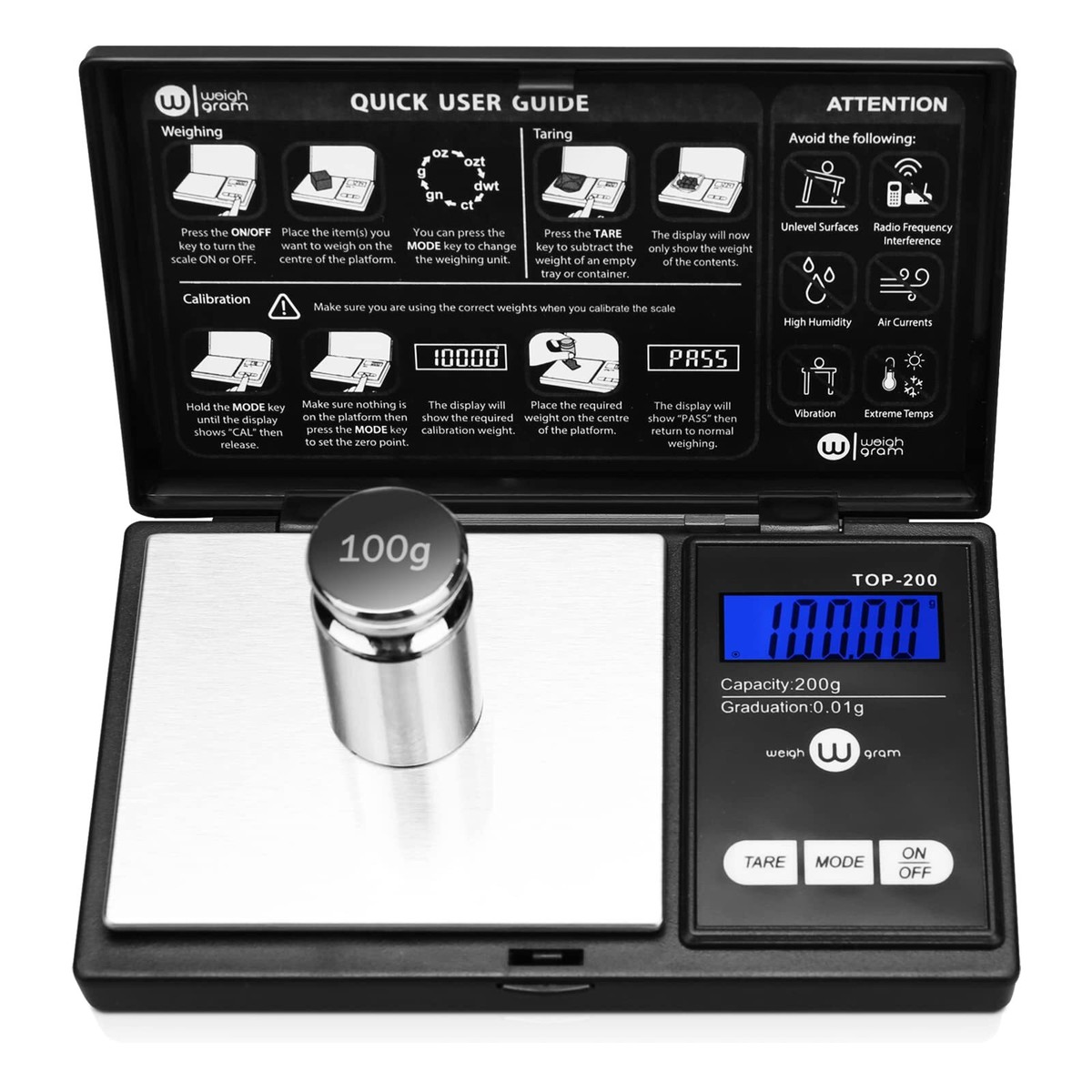
Weigh Gram 200 g × 0.01 g Digital Pocket Scale
Best for small specimens and straightforward grams-based weighing. Listed 200 g maximum and 0.01 g increments; compare whether calibration weight and batteries are included.
Check exact listing on Amazon ↗
Amazon price, seller and stock may change.
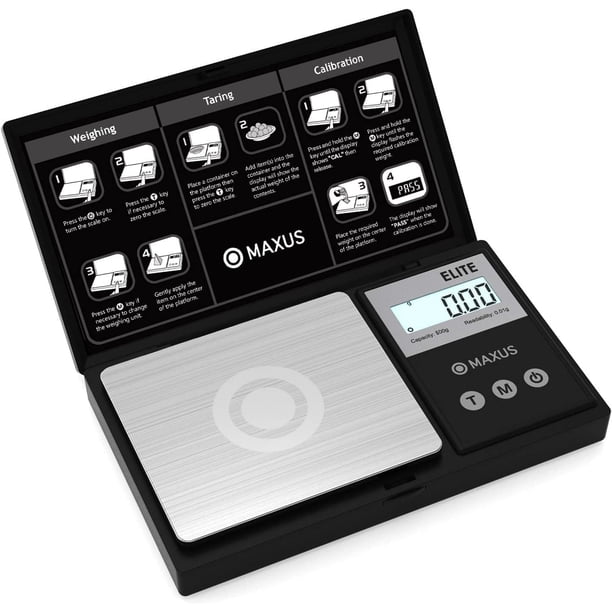
MAXUS 500 g × 0.01 g Precision Pocket Scale
Greater advertised weight capacity at the same 0.01 g displayed interval; useful for small collections and rough samples rather than specialist carat certification.
Check exact listing on Amazon ↗
Amazon price, seller and stock may change.
Affiliate disclosure: As an Amazon Associate, USA Rockhounding earns from qualifying purchases. Confirm the exact variant, current price and seller before buying. These are model-matched product photographs, not independent hands-on reviews.
What makes a digital gemstone scale genuinely useful?
The right scale depends on the mass and value of the stones you regularly handle. A pocket scale used to sort handfuls of quartz and rough agate has a different role from a precision balance used to value fine gemstones. Before comparing brands, determine your likely minimum sample weight, largest specimen, preferred unit and whether measurements are for personal inventory, educational comparison or commercial valuation. A low-cost digital device can organize a home collection, but its display resolution alone does not establish accuracy, repeatability or suitability for a high-value transaction. The two photographed scales above are useful entry points for comparing basic specifications, rather than laboratory-grade endorsements.
Readability is not the same as accuracy
A display that changes in 0.01 g increments has a stated resolution or readability of 0.01 g. That does not mean every reading is correct to within 0.01 g. The weighing mechanism has repeatability limits, calibration errors, sensitivity to placement and environmental effects. A scale might repeatedly show the same inaccurate number, or readings may wander when the same stone is placed in different locations on its platform. Seek a published tolerance or verification method appropriate to the intended application. If a listing provides only the headline number of decimal places, treat it as limited evidence of measurement quality.
Metric carats versus grams: the essential conversion
Gemstone weight is often expressed in metric carats. One metric carat equals exactly 0.20 gram, so one gram equals five carats. A 0.50 g stone weighs 2.50 ct; a 0.20 g stone weighs 1.00 ct. Because 0.01 g equals 0.05 ct, a pocket scale displaying hundredths of a gram does not directly resolve hundredths of a carat. This matters when weighing small faceted gems or comparing nearly identical small stones. Do not confuse carat, the unit of gemstone mass, with karat, a measure associated with gold purity. See the Gemological Institute of America’s public reference on carat weight when recording specimens for a serious collection.
Choosing between 200 g and 500 g capacity
The photographed Weigh Gram model offers an advertised 200 g maximum, while the MAXUS pocket model is advertised at 500 g. Both listings describe 0.01 g display intervals. The larger capacity provides more headroom for rough mineral samples, but does not automatically improve small-sample accuracy. A higher rated maximum is irrelevant if every object you expect to weigh is far smaller than the 200 g range. Likewise, a small scale may be unsuitable for chunky rough if a container plus stone exceeds its limit. Choose capacity based on the total load, including any holder or tray, not solely the estimated mass of the stone.
Why calibration matters before serious measurements
Calibration establishes how a weighing instrument responds to a known mass under specified conditions. Many pocket scales provide a user calibration routine, but the required reference-weight value and procedure depend on the exact device. Follow the model’s instructions rather than selecting an arbitrary coin as a standard. A household coin can provide a rough consistency check if its condition is known, but it is not equivalent to a verified calibration weight. Allow the scale to stabilize in its working environment and use an appropriate reference weight when accuracy matters. Record the date of the check when the measurement will later support a comparison or record.
Repeatability: a five-measurement field test
Place the scale on a flat stable platform, allow it to settle and zero it. Weigh one clean dry reference item, remove it fully, and repeat five times under the same conditions. Record each display result instead of noting only the average. If the last digit varies widely, look for drafts, hand contact, vibration or an unstable surface. If every value agrees, that supports repeatability for this item and environment, but it does not prove absolute accuracy. Try a second mass level relevant to your typical samples when appropriate. Do not overinterpret numerical consistency from a device that has not been calibrated.
Position sensitivity across the weighing pan
Small weighing platforms can respond differently when a specimen touches one edge or rests partly on the raised housing. Use a suitable small container to keep an irregular stone centered and stable. Tare the empty container, then lower the stone gently without dropping it. Avoid loading a sharp crystal directly onto a vulnerable sensor platform if it could scratch or puncture the surface. For each item, use a repeatable placement method. Where moving the same stone slightly changes the reading, the instrument or technique needs further investigation before that value is trusted for gemological decisions.
Tare function and weighing dishes
The tare button subtracts the mass of a container from the displayed measurement. A clean lightweight dish helps prevent small stones from rolling away, protects the platform, and can separate dusty or rough specimens from delicate surfaces. Check that the container itself does not consume too much of the scale’s capacity. If you change the dish, zero the scale again. Do not repeatedly add fragments and assume each new reading is independently precise: cumulative loading may carry errors and make the sample hard to track. For a mineral collection, label specimen bags separately and record the stone mass without inadvertently including protective packaging.
Common causes of wandering readings
Air movement from a fan or open window can cause the last digits to fluctuate. A soft carpet, flexible desk, loose shelf, nearby vibrating machine or unstable folding table can have similar effects. Static electricity, temperature changes, low batteries and residue on the platform may also interfere with consistency. Use a firm level surface away from draft sources; give the equipment adequate time to reach room conditions. If an item has just been washed, dry it fully before weighing. A stable environment improves low-cost instruments, but does not turn them into analytical balances with traceable calibration.
Handling raw rock versus a cut gemstone
Rough stones often have dust, soil, matrix and surface moisture that complicate weighing. Record whether the object includes matrix, attachments or packaging. If the sample is to be cleaned, avoid water or chemicals that could dissolve, damage or alter sensitive minerals. Cut gemstones need gentler handling to prevent edge chips and fingerprints. For multiple pieces, work over a clean tray so none is lost. Always describe the measured object consistently: a loose stone mass is not directly comparable to the total weight of a ring, mounted gem, protective box or glued display base.
When a pocket scale is not sufficient
High-value stone transactions, scientific samples, sub-carat gems and specialized density measurements may require equipment with finer resolution, documented calibration and controlled conditions. A laboratory or professional gemological balance may offer a draft shield, more detailed error specifications and specialized service support. Do not assume the cheapest instrument displaying two decimals can justify commercial carat-weight claims. If the purpose is valuation or certification, work to the required professional standard and retain records. For ordinary rockhounding trip inventories, an affordable pocket scale may still be convenient and proportionate to the task.
Weighing and estimating specific gravity
Specific gravity compares a material’s density with that of water under a defined reference condition. The hydrostatic technique typically uses a mass measurement in air and a properly managed immersed measurement. This requires secure specimen suspension, a stable fluid container, careful tare handling, bubble control and appropriate formulas. A pocket scale alone does not complete the process. Irregular specimens with pores, trapped air, attached matrix or water-sensitive components can produce misleading values. For a mineral identification question, combine density evidence with crystal habits, luster, streak and other safe tests instead of relying on a single calculated number.
Inventory documentation that supports comparisons
Give each specimen a unique identifier, record source locality as accurately as permitted, and note whether the measurement is for the entire sample or a detached fragment. Record the mass with the unit shown on the device, the date, and any special condition such as dampness or matrix. If you convert grams to carats, state that the result is calculated rather than independently measured at a finer precision. Clear specimen notes make it easier to identify true changes such as lost fragments or preparation work. Unlabeled bags and rounded figures can create bigger errors in a collection than the scale itself.
What to examine on the Amazon listing
Check the brand, exact scale capacity, display resolution, supported units, power source, tray, included calibration weight, and whether the current picture matches the stated model. Do not assume accessories shown in a marketplace image are included. Read the relevant instructions for calibration, maximum load and safe cleaning. A listing may combine several capacity variants under one parent product; confirm that the selected buying option is the 200 g or 500 g model described here. Current prices and seller availability can change, so the product link should be treated as a path to verify the specific offer, not a permanently guaranteed specification.
Comparing the two photographed models for collectors
The Weigh Gram 200 g unit may be sufficient for small loose specimens, hobbyist gemstone sorting and travel, assuming actual measurement performance is acceptable. MAXUS offers greater stated maximum load while retaining hundredth-gram display intervals; it may be more convenient for larger crystals and collections containing mixed sizes. Neither model should automatically be promoted as a certified gemstone balance. For the smallest high-value stones, investigate finer carat resolution and independent calibration. For large rock specimens, prioritize sufficient total capacity and a durable platform over additional display decimals that the environment cannot support.
Care, cleaning, and storage
Store the scale in a dry case away from loose grit, strong chemicals and striking tools. Use the protective lid according to its instructions, and remove debris without pushing abrasive powder into gaps. Do not submerge electronic scales or wash them under running water. Keep batteries in good condition and follow the manufacturer’s advice for long-term storage. Avoid extreme heat, vehicle-dashboard exposure and repeated impact. Recheck measurement behavior after travel or an accidental drop. A basic scale can remain useful for an extended period when its limitations are understood and its zero and repeatability are monitored.
Three mistakes to avoid
First, do not equate advertised resolution with a guarantee of exact mass. Second, do not convert a coarse measurement into a highly precise carat figure by adding decimal places: mathematical conversion cannot recover detail the instrument never measured. Third, do not use a pocket scale’s mass result as proof that a gemstone is genuine, untreated or valuable. Many different rocks can have similar mass, and a mineral’s value depends on numerous factors. A thoughtful measurement workflow and appropriate identification methods are more important than attractive product graphics or claims of professional performance.
Practical buying conclusion
For ordinary collectors weighing rough specimens and many loose stones, a compact scale with suitable capacity and a repeatable zero can be a useful addition to the field kit. Between the specific models above, choose the 200 g Weigh Gram for lower maximum loads and the 500 g MAXUS where extra capacity matters; do not claim either is necessarily more accurate without test evidence. When precision is important, choose verified calibration and the appropriate balance class. For complementary tools, review specific-gravity accessories, mineral identification methods, and gemological magnification.