Shark Teeth has been recorded at 52 places in 13 states on the USA Rockhounding map. Florida, Maryland and Virginia have the most. 15 are marked Ready, 11 Conditional and 22 research only, so check each place’s status before you go.

Shark Teeth sites by state
| State | Sites | Ready | State guide |
|---|---|---|---|
| Florida | 10 | 5 | Florida rockhounding map |
| Maryland | 9 | 3 | Maryland rockhounding map |
| Virginia | 6 | 1 | Virginia rockhounding map |
| Delaware | 5 | 1 | Delaware rockhounding map |
| South Carolina | 5 | 1 | South Carolina rockhounding map |
| Alabama | 4 | 1 | Alabama rockhounding map |
| New Jersey | 4 | 1 | New Jersey rockhounding map |
| North Carolina | 3 | 0 | North Carolina rockhounding map |
| Texas | 2 | 0 | Texas rockhounding map |
| Kansas | 1 | 0 | Kansas rockhounding map |
| Louisiana | 1 | 1 | Louisiana rockhounding map |
| Mississippi | 1 | 0 | Mississippi rockhounding map |
| Nebraska | 1 | 1 | Nebraska rockhounding map |
Places to find shark teeth
Sorted with Ready sites first.
- Shark Tooth Creek — Private Guided Fossil Hunt, Pickens / Greene County, Alabama: Ready
- C&D Canal — St. Georges Fossil Spoils, New Castle County, Delaware: Ready
- Stump Pass Beach State Park — Coastal Shark Teeth, Charlotte County, Florida: Ready
- Paleo Discoveries — Guided Peace River Fossil Hunt, Hardee County, Florida: Ready
- Fort Clinch State Park — Coastal Shark-Tooth Hunting, Nassau County, Florida: Ready
- Caspersen Beach — Public Shark-Tooth Search, Sarasota County, Florida: Ready
- Venice / Brohard Public Beach — Shark-Tooth Hunting, Sarasota County, Florida: Ready
- Red River Treasure Mine — Shreveport Aquarium, Caddo County, Louisiana: Ready
- Breezy Point Beach — Fossil and Shark-Tooth Collecting, Calvert County, Maryland: Ready
- Calvert Cliffs State Park — Designated Open Beach Fossil Collecting, Calvert County, Maryland: Ready
- Matoaka Beach — Fossil Collecting Access, Calvert County, Maryland: Ready
- Camp A Way — Gem Mining Waterfall Sluice, Lancaster County, Nebraska: Ready
- Big Brook Park Fossil Collecting Program, Monmouth County, New Jersey: Ready
- Charleston Fossil Adventures — Guided Barrier-Island Surface Hunt, Charleston County, South Carolina: Ready
- Westmoreland State Park — Fossil Beach Collecting, Westmoreland County, Virginia: Ready
- Alabama Museum of Natural History — Future Fossil Excursions, Black Belt / undisclosed managed creek sites County, Alabama: Conditional
- Peace River — Independent State-Land Fossil Hunting Context, Hardee / DeSoto County, Florida: Conditional
- SIFT Tours — Guided Florida Fossil Dig, Hardee / DeSoto County, Florida: Conditional
- Florida State-Land Vertebrate Fossil Permit Context, Statewide County, Florida: Conditional
- Bayfront Park / Brownies Beach — Resident-Only Fossil Collecting, Calvert County, Maryland: Conditional
- Flag Ponds Nature Park — Fossil Hunting and Beach Combing, Calvert County, Maryland: Conditional
- Douglas Point Natural Area — Low-Tide Shoreline Fossil Collecting, Charles County, Maryland: Conditional
- Nanjemoy WMA — Purse Area Fossil Hunting, Charles County, Maryland: Conditional
- South Carolina Public Beach Fossil Surface Collection, Charleston / Beaufort / Colleton / Georgetown / Horry County, South Carolina: Conditional
- York River State Park — Fossil Beach Collecting, James City County, Virginia: Conditional
- Chippokes State Park — James River Fossil Collecting, Surry County, Virginia: Conditional
- Shark Tooth Creek Appointment Non-Bleed, Pickens / Greene County, Alabama: Rules apply
- Florida Fossil Class Gate, Statewide County, Florida: Rules apply
- State Park Coastal Exception Boundary, Statewide County, Florida: Rules apply
- Coastal Access/Removal Firewall, Coastal counties County, North Carolina: Rules apply
- Alabama Black Belt Cretaceous Fossil Research, Pickens / Greene / Hale / Sumter / Marengo / Dallas / Perry / Wilcox County, Alabama: Research only
- Central Delaware Miocene Shark Research, Kent County, Delaware: Research only
- Pollack Farm Miocene Fossil Site Research, Kent County, Delaware: Research only
- C&D Canal Shark Tooth and Ray Fossil Research, New Castle County, Delaware: Research only
- Marshalltown Formation Fossil Research, New Castle County, Delaware: Research only
- Western Interior Seaway Fossil Research, Western Kansas County, Kansas: Research only
- Calvert Cliffs Shark-Tooth Research, Calvert County, Maryland: Research only
- Aquia Formation Fossil Research, Charles County, Maryland: Research only
- Sharkey County Geology and Rock/Fossil Research, Sharkey County, Mississippi: Research only
- Ramanessin Brook Fossil Research, Monmouth County, New Jersey: Research only
- Shark River Fossil Research, Monmouth County, New Jersey: Research only
- New Jersey Fossil Shark Tooth Research, Monmouth / Gloucester / Burlington County, New Jersey: Research only
- Atlantic Beach Shark-Tooth Research, Brunswick / New Hanover / Pender / Onslow / Carteret / Dare County, North Carolina: Research only
- North Carolina Coastal Plain Fossil Research, Eastern North Carolina County, North Carolina: Research only
- Charleston Fossil Beds Research, Charleston County, South Carolina: Research only
- South Carolina Beach Shark-Tooth Research, Charleston / Beaufort / Colleton / Georgetown / Horry County, South Carolina: Research only
- South Carolina Submerged Fossil Research, Statewide navigable waters County, South Carolina: Research only
- Post Oak Creek / Sherman Shark-Tooth Locality, Grayson County, Texas: Research only
- North Texas Shark-Tooth Regional Context, Grayson / Fannin / Dallas County, Texas: Research only
- Virginia Coastal Plain Shark Teeth, Coastal Plain County, Virginia: Research only
- Yorktown Formation Fossil Research, Coastal Plain County, Virginia: Research only
- Westmoreland / Potomac Fossil Geology, Westmoreland County, Virginia: Research only
Why fossil shark teeth are so common
A shark sheds and replaces thousands of teeth in its lifetime, and teeth are made of hard enamel-like material that fossilises well. Wherever ancient seas covered the land, especially in the Cretaceous, Miocene and Pliocene, the sediments are full of them. Most fossil teeth are black, grey or brown because minerals from the surrounding sediment replaced the original material.
State guides: Shark teeth in Florida · Shark teeth in Maryland · New Jersey shark teeth · South Carolina shark teeth · Westmoreland shark teeth
How to identify a fossil shark tooth
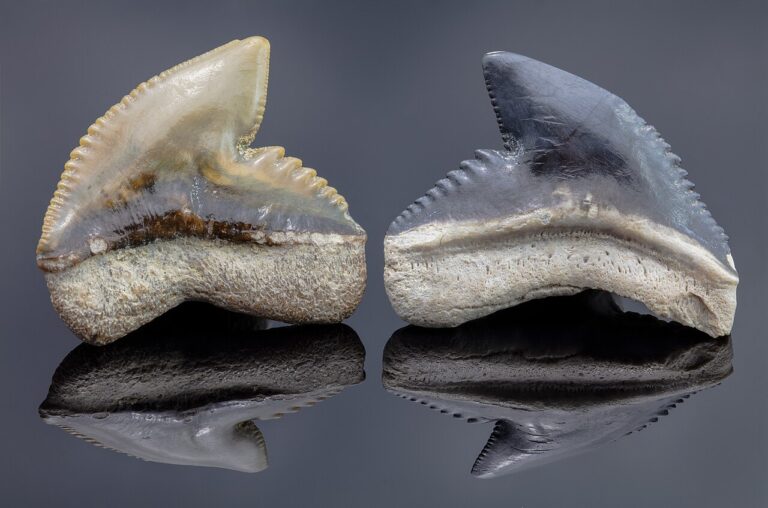
- A triangular blade with a root at the base, often with a darker, glossier blade and a lighter root.
- Serrated edges on teeth from species such as megalodon, tiger and great white relatives; smooth edges on mako and sand tiger teeth.
- Fossil teeth are heavier and harder than modern ones and are usually dark in colour.
- Ray teeth look like small flat plates or pavement tiles.
Where to find shark teeth in the United States
Florida is the best-known state, especially the beaches around Venice and the Peace River near Arcadia. South Carolina’s rivers and beaches, the Chesapeake Bay shore in Maryland (such as Calvert Cliffs), fossil beaches in Virginia’s state parks, Big Brook in New Jersey, and the Aurora Fossil Museum in North Carolina are also popular. In Texas, the North Sulphur River and other Cretaceous streams produce teeth. The table above shows mapped places by state.
How to find shark teeth
- On beaches, search the shell line at the water’s edge, especially at low tide and after storms.
- Use a sifting screen (a quarter-inch mesh works well) in shallow water or gravel.
- In rivers and creeks, dig gravel from bars and riffles and sift it.
- Look for the shiny, triangular shape and dark colour among shell fragments.
Rules for collecting shark teeth
Shark teeth are vertebrate fossils, so federal land rules that protect vertebrate fossils apply in national parks and on BLM land. Florida specifically allows fossil shark and ray teeth to be collected on most state land without a permit, while other vertebrate fossils need a Florida Fossil Permit. South Carolina requires a hobby diver licence to collect fossils from its rivers. Many state parks do not allow collecting, but some, such as Westmoreland State Park in Virginia, allow collecting on a designated fossil beach.
Questions
Where is the best place to find shark teeth?
Venice, Florida, and the Peace River near Arcadia are the best-known places. South Carolina rivers, Calvert Cliffs in Maryland, Westmoreland State Park in Virginia and Big Brook in New Jersey are also popular.
Do you need a permit to collect shark teeth?
Not on most Florida state land, which allows fossil shark and ray teeth without a permit. South Carolina requires a hobby diver licence for river fossils, and many parks have their own rules.
How do you find shark teeth on the beach?
Search the shell line at the water’s edge at low tide, especially after storms, and sift sand and gravel with a quarter-inch screen.
What the map statuses mean is explained in how map statuses work; collecting rules for each kind of land are in rules by land type.
Other rocks and minerals
Agate · Geodes · Quartz · Jasper · Petrified Wood · Fossils · Gold · Garnet · Sapphire · Crystals · Calcite · Chalcedony · Copper · Diamonds · Fluorite · Mica · Pyrite · Beryl, Aquamarine & Emerald · Tourmaline
Data: USA Rockhounding atlas records, checked through 2026-08-30. See all rocks and minerals.